AV
Over the past few years, I’ve worked across multidisciplinary teams, partnering with product managers, engineers, and stakeholders to design solutions that are both user-centred and technically grounded.
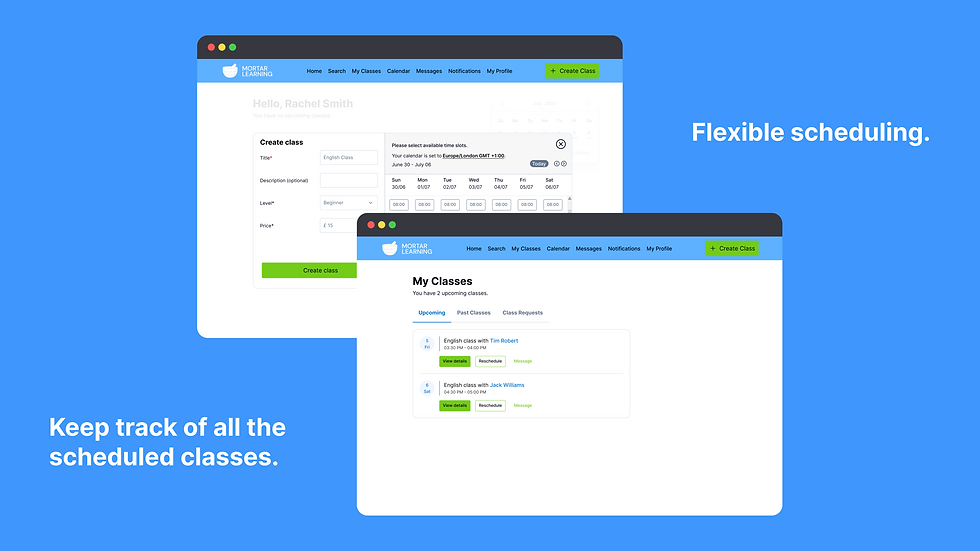
Designing an MVP for a language learning platform empowering learners and tutors
Client
Mortar Learning
Industry
EdTech
Platform
Web
Team
1 Project Manager
1 Developer
2 Data Analysts
1 Product Designer
My Role
Product Designer
Timeline
March 2024-Present
Designing scalable digital learning experience for industrial operators
Leading the design and delivery of accessible, large-scale digital learning modules for global petrochemical organisations
Client
Petro Rabigh
Aramco
Industry
Energy/Industrial
Enterprise Learning
Platform
Web-based
e-learning (SCORM)
LMS delivery
Team
Instructional Designers
E-learning developers
Content Writers
Multimedia Designers
SMEs
My Role
Team Lead –
E-learning Development
Learning Experience Design
Timeline
2018–2022
Over the past few years, I’ve worked across multidisciplinary teams, partnering with product managers, engineers, and stakeholders to design solutions that are both user-centred and technically grounded.
How I Work
I approach design as a decision-making discipline, not just a creative one.
That means:
Starting with problem framing, not screens
Understanding technical, business, and human constraints early
Designing for real-world conditions, not ideal scenarios
Making trade-offs explicit and intentional
I value clarity over complexity, and I focus on designing experiences that are simple to use, resilient under pressure, and scalable over time.

How I Work
I approach design as a decision-making discipline, not just a creative one.
That means:
Starting with problem framing, not screens
Understanding technical, business, and human constraints early
Designing for real-world conditions, not ideal scenarios
Making trade-offs explicit and intentional
I value clarity over complexity, and I focus on designing experiences that are simple to use, resilient under pressure, and scalable over time.

How I Work
I approach design as a decision-making discipline, not just a creative one.
That means:
Starting with problem framing, not screens
Understanding technical, business, and human constraints early
Designing for real-world conditions, not ideal scenarios
Making trade-offs explicit and intentional
I value clarity over complexity, and I focus on designing experiences that are simple to use, resilient under pressure, and scalable over time.

How I Work
I approach design as a decision-making discipline, not just a creative one.
That means:
Starting with problem framing, not screens
Understanding technical, business, and human constraints early
Designing for real-world conditions, not ideal scenarios
Making trade-offs explicit and intentional
I value clarity over complexity, and I focus on designing experiences that are simple to use, resilient under pressure, and scalable over time.
How I Work
I approach design as a decision-making discipline, not just a creative one.
That means:
Starting with problem framing, not screens
Understanding technical, business, and human constraints early
Designing for real-world conditions, not ideal scenarios
Making trade-offs explicit and intentional
I value clarity over complexity, and I focus on designing experiences that are simple to use, resilient under pressure, and scalable over time.

Overview
I worked as a Team Lead and Consultant – E-Learning Development at Ingerem India, delivering large-scale digital learning programmes for Petro Rabigh Corporation and Aramco. These courses were designed for plant operators and technical staff working in high-risk, industrial environments.
I worked closely with instructional designers and subject matter experts, translating structured learning content into clear, accessible, and usable digital learning experiences. In addition to development, I contributed to decisions around navigation, interaction patterns, accessibility, and learner engagement.
Due to the sensitive nature of the content and clients, this case study focuses on process, decision-making, and outcomes, rather than visual artefacts.
Core Problem
Operators using these learning modules:
Came from varied age groups
Had mixed digital literacy levels
Often accessed training in time-constrained or high-pressure contexts
The challenge was to ensure that learning experiences were:
Easy to navigate
Visually clear and accessible
Consistent across large volumes of content
Scalable for future updates
Core Problem
Operators using these learning modules:
Early exploration revealed that many existing English learning platforms introduced high onboarding friction, requiring teachers to complete long, multi-step flows before being able to teach or earn.
The core problem, therefore, was not feature completeness; it was reducing time and effort required for teachers to become active.
Goals
-
Minimise friction during teacher onboarding
-
Enable teachers to reach “ready to teach” status as quickly as possible
-
Balance simplicity with necessary verification requirements
-
Establish a scalable onboarding foundation for future features
Constraints
-
Early-stage MVP with limited engineering capacity
-
No historical product data or live metrics
-
Onboarding needed to support future verification and monetisation flows
-
Organisational uncertainty impacting delivery timelines
These constraints shaped both the scope and level of confidence we could design for.
Discovery & Insights
Discovery was intentionally lean and focused, using:
-
Competitive analysis of established English learning platforms
-
Stakeholder discussions with the founder and product manager
-
Early qualitative feedback from prospective teachers
Key Insight
Competitor onboarding flows often extended to six or seven steps, front-loading complexity before teachers experienced any value. This created friction at the exact moment when motivation was highest.
Teachers prioritised:
-
Speed
-
Clarity
-
Confidence that onboarding would lead to real teaching opportunities
Key Design Decisions
1. Treat onboarding as an activation problem, not a form-filling task
Rather than designing onboarding to capture all possible information upfront, we prioritised activation over completeness.
The primary question became:
“What is the minimum required for a teacher to start teaching?”
2. Reduce onboarding to three intentional steps
Based on competitive analysis, we designed a three-step onboarding flow:
-
Account creation and basic profile
-
Teaching credentials and availability
-
Review and publish
This reduced cognitive load and made progress immediately visible, while still supporting future expansion.
Trade-off:
This limited profile depth at onboarding, but significantly reduced the risk of early abandonment.
3. Use progressive disclosure for advanced setup
More complex tasks (profile optimisation, additional credentials, preferences) were deferred until after onboarding.
This allowed teachers to:
-
Complete onboarding quickly
-
Refine their profiles once value was established
4. Prioritise clarity and feedback at every step
Each step included:
-
Clear progress indicators
-
Inline validation
-
Microcopy designed to reduce uncertainty
The goal was to ensure teachers always understood:
-
Where they were
-
What was required
-
What would happen next
Key Design Decisions
1. Treat onboarding as an activation problem, not a form-filling task
Rather than designing onboarding to capture all possible information upfront, we prioritised activation over completeness.
The primary question became:
“What is the minimum required for a teacher to start teaching?”
2. Reduce onboarding to three intentional steps
Based on competitive analysis, we designed a three-step onboarding flow:
-
Account creation and basic profile
-
Teaching credentials and availability
-
Review and publish
This reduced cognitive load and made progress immediately visible, while still supporting future expansion.
Trade-off:
This limited profile depth at onboarding, but significantly reduced the risk of early abandonment.
3. Use progressive disclosure for advanced setup
More complex tasks (profile optimisation, additional credentials, preferences) were deferred until after onboarding.
This allowed teachers to:
-
Complete onboarding quickly
-
Refine their profiles once value was established
4. Prioritise clarity and feedback at every step
Each step included:
-
Clear progress indicators
-
Inline validation
-
Microcopy designed to reduce uncertainty
The goal was to ensure teachers always understood:
-
Where they were
-
What was required
-
What would happen next
Key Design & Delivery Decisions
Decision 1: Navigation-first content structure
I focused on designing clear information architecture and predictable navigation patterns so learners could move through content confidently without cognitive overload.
Decision 2: Accessibility as a baseline
I prioritised:
High contrast colour usage
Clear typographic hierarchy
Readable font sizes for prolonged viewing
WCAG-aligned interaction patterns
This ensured modules were usable across age groups and varying visual capabilities.
Decision 3: Modular content frameworks
I introduced modular layouts and reusable interaction patterns, allowing teams to:
Reduce development time
Maintain consistency
Scale content without rework
This approach reduced development effort for new modules by approximately 30%.
Key Design Decisions
Key Design Decisions
Decision 4: Engagement without distraction
Rather than heavy animation or novelty, I encouraged:
Purposeful interactions
Lightweight gamification where appropriate
Clear feedback mechanisms
This resulted in a measured increase in engagement and knowledge retention by 25%.
Design Execution
-
Designed user flows, information architecture, and wireframes
-
Created interactive Figma prototypes to validate flows internally
-
Established early design guidelines to support consistency across the MVP
-
Collaborated closely with Engineering to ensure designs were technically feasible and realistic for the MVP timeline
Collaboration & Leadership
As a team lead, I:
Oversaw multiple development streams simultaneously
Reviewed work for consistency, accessibility, and usability
Facilitated feedback loops between SMEs, designers, and developers
Supported junior developers through mentoring and review
I also conducted usability reviews and iterated based on learner performance data where available.
Outcomes & Impact
Improved learner engagement and retention by 25%
Reduced development time through modular frameworks
Delivered consistent, accessible learning experiences at scale
Strengthened collaboration across large, cross-functional teams
What This Work Achieved
While live metrics were not available, this work:
-
De-risked the onboarding approach before MVP launch
-
Established a clear activation-first design direction
-
Created alignment between product, design, and engineering on what mattered most
What I’d Improve Next
If development resumes, the next steps would include:
-
Validating onboarding completion and activation rates
-
Testing variations of the onboarding flow
-
Introducing adaptive onboarding based on teacher experience level
Key Learnings
-
In early-stage products, simplicity is a strategic decision, not a visual preference
-
Activation matters more than completeness during onboarding
-
Designing for future scale does not require upfront complexity
Temp
I approach design as a decision-making discipline, not just a creative one.
That means:
-
Minimise friction during teacher onboarding
-
Enable teachers to reach “ready to teach” status as quickly as possible
-
Balance simplicity with necessary verification requirements
-
Establish a scalable onboarding foundation for future features
I value clarity over complexity, and I focus on designing experiences that are simple to use, resilient under pressure, and scalable over time.
Let's work together
If you’re building products that value clarity, usability, and thoughtful design, I’d be glad to explore how I can contribute.